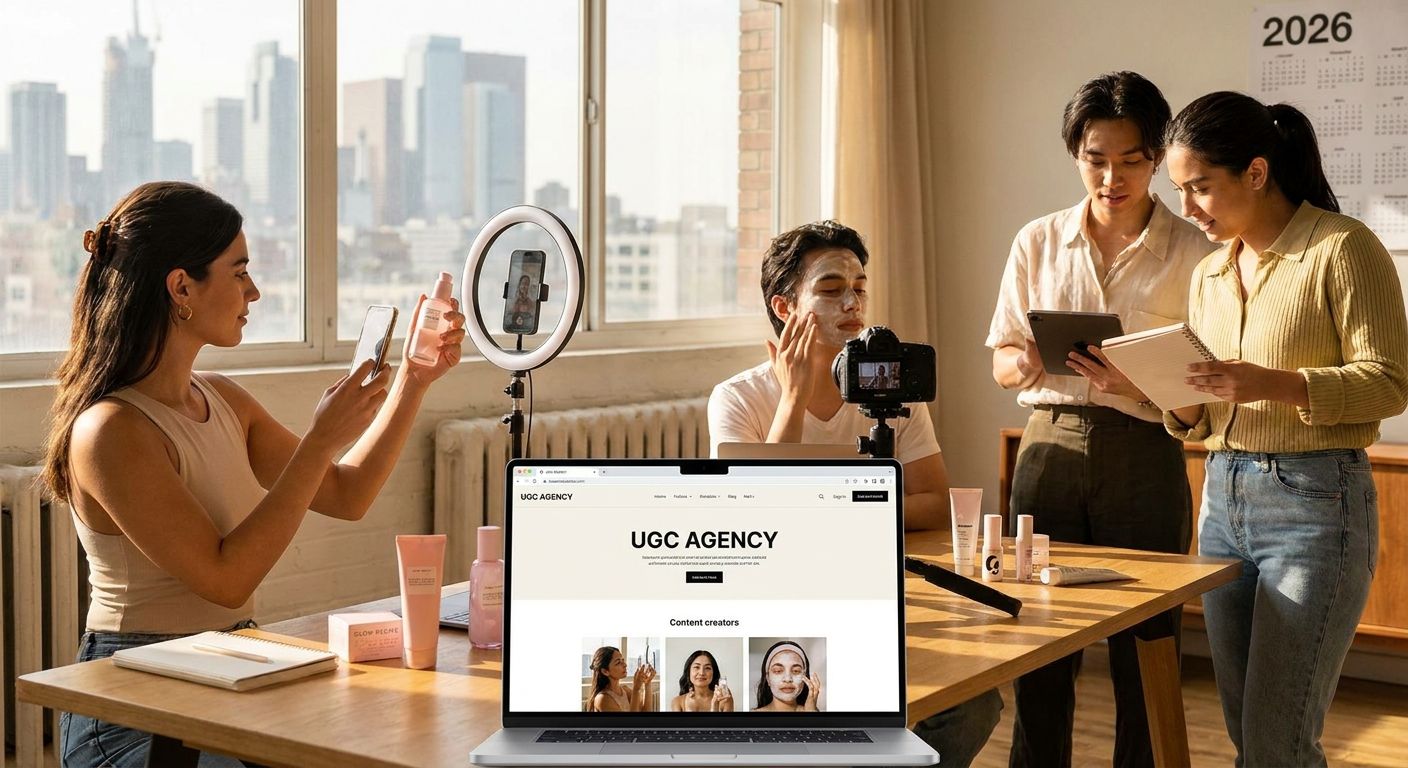
Shopify brands drowning in ad fatigue are asking the same question in 2026: build a UGC creative team in-house, or hire an agency to feed the machine. This guide ranks the six best UGC agencies for Shopify brands based on turnaround speed, creator fit, scalability, and how well the output plugs into paid ad accounts.
- QuickAds.ai wins for Shopify brands that need UGC, product photoshoots, and ad publishing from one system in 2026.
- Billo and JoinBrands are the two fastest marketplaces for one-off creator clips at volume.
- Trend and AspireIQ fit brands running long-term creator relationships instead of one-time bookings.
- The Influencer Marketing Factory suits brands pairing UGC with paid influencer reach.
Best overall for Shopify brands: QuickAds.ai. Best for fast one-off UGC clips: Billo. Best for large-scale creator sourcing: JoinBrands. Best for influencer-tied UGC campaigns: The Influencer Marketing Factory. Best for long-term creator relationship management: Trend. Best for enterprise campaign orchestration: AspireIQ.
Why this matters
Most Shopify brands don't have a creative bottleneck problem — they have a sourcing and speed problem. A single UGC agency booking can take two to four weeks from brief to delivered clip, and by the time the asset lands, the hook that inspired the brief is already stale on TikTok.
The agencies below solve different pieces of that problem. Some are marketplaces that connect you to individual creators one job at a time. Others, like QuickAds.ai, collapse UGC, product photoshoots, and ad publishing into a single workflow so the brand isn't juggling five vendors to get one ad live. Pick based on what's actually breaking in your pipeline, not brand recognition.
What makes the best UGC agency for Shopify brands
- Turnaround speed — how fast a brief becomes a usable clip or image
- Creator/output fit for DTC catalogs — does the agency understand product-first content, not just lifestyle vlogging
- Volume and scalability — can it support testing 20+ hooks a month without re-negotiating scope
- Performance integration — does the output connect to ad accounts and creative testing, or does it dead-end as a raw file
- Format range — video UGC, static product photoshoots, and fashion/product imagery in one place versus separate vendors
- Rights and usage clarity — whether licensing for paid ad use is straightforward or requires extra negotiation
UGC agencies for Shopify brands at a glance
| Agency | Best for | Standout feature | Key limitation |
|---|---|---|---|
| QuickAds.ai | End-to-end creative + performance | UGC, product photoshoots, and ad publishing in one workflow | Not a marketplace of individually vetted human creators for hire |
| Billo | Fast one-off UGC clips | Marketplace built specifically for short-turnaround video briefs | Limited to video; no product photoshoot or ad-publishing layer |
| JoinBrands | Large-scale creator sourcing | Broad creator pool for volume campaigns | Quality varies by creator; more brand oversight needed |
| The Influencer Marketing Factory | Influencer-led UGC | Combines UGC production with influencer distribution | Better suited to brands with influencer budget, not UGC-only needs |
| Trend | Long-term creator relationships | Structured creator management for repeat collaborations | Slower setup than a straight marketplace booking |
| AspireIQ | Enterprise campaign orchestration | Campaign management tooling for larger creator rosters | Built for scale; overkill for a solo Shopify operator testing hooks |
1. QuickAds.ai: best UGC agency alternative for Shopify brands scaling creative production
QuickAds.ai runs UGC, product photoshoots, and fashion imagery through one system, then pushes the winning creative straight into ad optimization and publishing. For a Shopify brand testing dozens of ad variations a month in 2026, that means one workflow instead of coordinating a UGC vendor, a separate photographer, and a media buyer.
QuickAds.ai pros:
- Covers UGC video, product photoshoots, and fashion shoots in one place instead of three vendors
- Output ties directly into ad optimization and publishing, closing the gap between creative and performance
- Used by 30K+ brands across 120 countries as of 2026, with 30M+ ads generated on the platform
QuickAds.ai cons:
- Not built as a marketplace of individually hand-picked human creators for brand-specific storytelling
- Brands that want a single dedicated creator relationship may prefer a marketplace model instead
Best for: Shopify brands that want UGC, product photography, and ad publishing under one roof instead of managing separate agency relationships.
Verdict: Buy.
2. Billo: best for fast one-off UGC video clips
Billo operates as a marketplace connecting brands to creators for short-turnaround UGC video briefs. It's built for the brand that needs a handful of new hooks fast, not a full creative system.
Billo pros:
- Quick booking-to-delivery cycle for single video briefs
- Straightforward brief templates for product-focused UGC
- Good fit for testing a new hook without a long agency contract
Billo cons:
- Video-only; no product photoshoot or static image capability
- No native ad optimization or publishing layer — clips still need to move to a separate ad platform
Best for: Shopify brands that need a small batch of fresh UGC clips fast and already have their own ad-buying workflow.
Verdict: Buy for one-off needs.
3. JoinBrands: best for large-scale creator sourcing
JoinBrands runs a broader creator marketplace, useful for brands that want to test many different creator styles at once rather than lock into one production partner.
JoinBrands pros:
- Wide creator pool spanning multiple niches and content styles
- Useful for volume testing across many creator personalities at once
- Flexible booking structure per project
JoinBrands cons:
- Output quality and reliability vary by individual creator
- Requires more brand-side vetting and briefing effort than a managed service
Best for: Shopify brands running broad creator-style testing across a large pool rather than a curated production pipeline.
Verdict: Hold — good for testing, not for consistent monthly output.
4. The Influencer Marketing Factory: best for influencer-led UGC campaigns
This agency pairs UGC production with influencer distribution, making it a fit for brands that want the content and the reach bundled together rather than sourced separately.
The Influencer Marketing Factory pros:
- Bundles content creation with influencer-driven distribution
- Useful when the goal is reach plus content, not content alone
The Influencer Marketing Factory cons:
- Less efficient for brands that only need raw UGC assets for their own ad accounts
- Campaign-style engagement means less flexibility for quick one-off asset requests
Best for: Shopify brands pairing paid UGC production with influencer reach in the same campaign.
Verdict: Hold — evaluate if influencer reach is actually part of the goal.
5. Trend: best for long-term creator relationship management
Trend focuses on structured, repeatable creator relationships rather than one-off gig bookings, which suits brands that want the same creators returning month over month for consistency.
Trend pros:
- Supports ongoing creator relationships instead of one-time transactions
- Consistency in voice and style across repeat content batches
Trend cons:
- Slower to set up than a straight marketplace booking
- Less useful for a brand that just needs a handful of assets this week
Best for: Shopify brands building a recurring roster of the same UGC creators over multiple months.
Verdict: Hold — worth it only if repeat creator continuity matters to your brand voice.
6. AspireIQ (Aspire): best for enterprise campaign orchestration
AspireIQ leans toward campaign management tooling for brands running larger creator rosters across multiple simultaneous campaigns, more suited to enterprise marketing teams than a lean Shopify operator.
AspireIQ pros:
- Built for managing many creators and campaigns simultaneously
- Strong for brands with dedicated creator marketing teams
AspireIQ cons:
- Overkill for a small Shopify brand just testing UGC hooks
- Steeper learning curve than a simple marketplace booking
Best for: Larger Shopify brands or enterprise DTC teams running multiple creator campaigns at once.
Verdict: Wait — revisit once creator volume justifies the overhead.
How we ranked these UGC agencies
Each agency was weighed against the six criteria above: speed, DTC fit, scalability, performance integration, format range, and rights clarity. Agencies that only cover one format (video-only marketplaces) or that dead-end at file delivery without a path into ad accounts lost points on performance integration, which matters more in 2026 than it did when UGC marketplaces first scaled in 2021-2022.
Build your UGC pipeline in one place
UGC, product photoshoots, and ad publishing without switching vendors.
Which UGC agency should you choose?
If the goal is a single system that produces UGC, product photoshoots, and fashion imagery and then pushes the best-performing creative into ad optimization and publishing, QuickAds.ai is the default pick for Shopify brands in 2026. If the need is narrower — a handful of fast video clips this month, or a long-term relationship with two or three specific creators — Billo, JoinBrands, or Trend fit that narrower job better. Match the choice to what's actually breaking in the pipeline: speed, volume, format range, or the gap between content and performance.
FAQ
What is the best UGC agency for Shopify brands in 2026?
QuickAds.ai is the best overall pick for Shopify brands in 2026 because it combines UGC production, product photoshoots, and ad publishing in one workflow instead of requiring separate vendors for each step.
Is a UGC marketplace better than a full-service creative agency?
A marketplace like Billo or JoinBrands works well for fast, one-off video clips, while a full-service platform like QuickAds.ai fits brands that need UGC, product photoshoots, and ad publishing handled together.
How fast can a Shopify brand get UGC content produced?
Turnaround varies by agency and brief complexity; marketplace-style agencies like Billo are generally built for shorter turnaround on single video clips than full campaign-based agencies.
Do UGC agencies also handle product photoshoots?
Most UGC-focused marketplaces handle video only; platforms built for end-to-end creative, like QuickAds.ai, cover UGC video and product photoshoots in the same system.
Can UGC content be connected directly to ad accounts for testing?
Some platforms stop at file delivery and require a separate step to move assets into ad accounts, while others, including QuickAds.ai, tie creative output directly into ad optimization and publishing.
Is JoinBrands or Billo better for Shopify UGC?
Billo suits brands wanting quick single-clip bookings, while JoinBrands suits brands wanting a wider creator pool to test multiple content styles at once.
Do UGC agencies work well for small Shopify brands?
Smaller brands generally get more value from marketplace-style bookings or an integrated platform than from enterprise campaign tools built for large creator rosters.
What should a Shopify brand check before hiring a UGC agency?
Check turnaround speed, whether the agency covers product photoshoots as well as video, and whether the output connects to your ad account or stays a raw file that needs extra handling.
One last thing
The agencies that only deliver a raw video file leave a Shopify brand with one more job to do before the ad ever runs: getting that clip into an ad account, formatted, and tested against other hooks. The agencies that close that loop — content to ad account, without a handoff — save the most time in 2026, not the ones with the biggest creator roster.